
Visual artist. Virtual world explorer.
Between virtual worlds and disappearing ones.
“Digital creation, rised to that level of technical quality
and emotion and because it is now able to ‘make universally
transmissible what is inexpressible’, is really an art in
the sense of Kant, and will be the more contemporary art
thanks to creators like Hugo Arcier.”
Jean-Luc Chalumeau, art critic and art historian.
ARTISTIC APPROACH
Since the beginning of his artistic practice in the early 2000s, Hugo Arcier has been exploring computer-generated images and virtual worlds to interrogate their nature and our perception of them. His work exists at the intersection of technology, poetic observation, and reflection on reality. Each project functions as a lens, allowing the viewer to understand digital universes that are often little known, while highlighting their construction and specificities.
Ghost City (2016) marks a turning point in his artistic development. The work introduces the notion of surface as a subject of reflection. Through a digital cutting process, the surfaces of objects – mountains, buildings, rocks – become visible, revealing their hollow and illusory nature. This approach highlights the particularity of virtual worlds: everything is made of surfaces that create the illusion of volume, like a theater set whose artifice is revealed by a simple change of perspective. By making these surfaces visible, Arcier transforms the constituent elements of the digital world into the very material of perception, inviting a careful and critical reading of the virtual image.
This exploration of surfaces continues with De Rerum Natura (2019), which applies the same principle to a vegetal universe. The work becomes a metaphor for the disappearance of ecosystems and the threats facing the environment. The title, borrowed from Lucretius’ poem, emphasizes that what we perceive is often only an envelope behind which invisible processes unfold. The video creates a poetic and analytical space, where contemplation is combined with an ecological awareness.
The project Limbus deepens this reflection by exploring spaces hidden beneath the levels of a video game. These limbos, ghost zones where nothing manifests according to the rules of the visible world, become contemplative landscapes and architectures of disappearance. The work invites the viewer to confront absence and to perceive spaces that exist without human presence, questioning the relationship between fullness and emptiness, between the visible and the invisible. The experience reveals the richness of the invisible and the capacity of digital worlds to generate unprecedented sensations.
Yuri’s Metamorphosis demonstrates Arcier’s ongoing interest in the intersection of ecological phenomena and digital representation, blending conceptual rigor with immersive experience.
Throughout his practice, Arcier engages with fragility, transformation, and disappearance, whether in digital surfaces, vegetal ecosystems, unexplored virtual spaces, or evolving landscapes. These themes shape a body of work that combines conceptual rigor and poetry, using digital technologies to reveal invisible or overlooked phenomena and to encourage a careful, attentive gaze on the world.
Arcier’s immersive projects, whether interactive or contemplative, demonstrate that technology is not merely a tool for visual production but a device capable of transforming perception. It allows for an extension of experiential time, a dilation of space, and the introduction of the viewer into environments in flux where the visible and invisible coexist. These setups create situations in which contemplation and reflection intertwine, inviting a renewed perception of both nature and virtual spaces.
The tension between presence and absence, between the visible and the invisible, is a guiding thread throughout his work. Whether it is the hollow surfaces of Ghost City, the cut vegetation of De Rerum Natura, the unexplored limbos of Limbus, or the transforming landscapes of Yuri, each project makes perceptible what usually escapes the eye. Absence and emptiness become sensitive materials, transforming the viewer’s apprehension of the world.
His work also engages in an ongoing dialogue with philosophical and scientific thought. The notion of surface, the questioning of materiality and disappearance, and the attention to the transformation of ecosystems and virtual landscapes all contribute to experiences that are both poetic and analytical. The works invite reflection on the relationship between reality and virtuality, perception of the fragility of natural environments, and the way we inhabit digital and real spaces.
In summary, Hugo Arcier’s work articulates four main axes: the deconstruction of computer-generated images and the materiality of digital surfaces, the poetic and ecological exploration of ecosystems, immersion in unexplored or contemplative spaces, and reflection on time, disappearance, and transformation. Each project creates unique conditions for observation, inviting the viewer to slow down, perceive, contemplate, and reflect on the surrounding world, whether natural or digital.
BIOGRAPHY
Hugo Arcier is a French visual artist who uses 3D computer graphics in various ways: video installations, prints and sculptures.
Devoted first to visual effects for feature films, he has worked on numerous projects with directors such as Roman Polanski, Alain Resnais or Jean-Pierre Jeunet.
This profession has allowed him to gain a deep understanding of digital tools – in particular 3D graphic images – which is essential for the birth of his projects.
Since 2004 he develops plastic and reflective artworks that meticulously dissect the specificities of 3D computer graphics and virtual worlds, being part of a new form of art.
His artistic works have been featured in numerous festivals (Elektra, Videoformes, Némo, etc.), in collective exhibitions in galeries and art venues (Le 104, New Museum, Palais de Tokyo, New Media Art Center of Sichuan Fine Arts Institute, galerie Magda Danysz, galerie Plateforme, etc.) and contemporary art fairs (Variation, Slick).
His works has been shown in two monographic exhibitions in France:
“Nostalgie du réel” in 2013 at Le Cube, and “Fantômes numériques” in 2016 at Lux Valence.
He was named “Chevalier de l’ordre des Arts et des Lettres” in 2016 by the French minister of Culture Audrey Azoulay.
He is the founder and creative director of N°130 Creative Studio
He is active member of the artist-run space Plateforme Paris.
Copyright managed by ADAGP.
INTERVIEW
Interview for Videoformes 2026
VRAL Milan Machinima Festival
Opéra de Paris, about Clinamen
Travelogue (exhibition)
Game / Video Art. A survey (exhibition and book)
“Philosophie – La culture” (documentary) FRENCH
PRESS REVIEW
Fisheye Immersive
Selected to open the event, Hugo Arcier and Annabelle Playe present Ars Natura, an audiovisual performance (first unveiled at L.E.V. Gijón) where science fiction becomes both intimate and cosmic. Far from serving as a simple pastoral backdrop, nature emerges as a landscape sculpted by human hands—at once wild and unreal. Completely immersed, the audience is left wondering whether they are still on Earth or already inside a post-Anthropocene simulation. A remarkable opening performance.
Read the full article here.
Artpress
The artist reinforces this immaterial quality, reminiscent of the video game industry, with an endless forward tracking shot that simultaneously reveals and swallows the city. It is as if the act of seeing annihilated its subject. One is also reminded of archaeologists of the present moment whose mere presence, added to the scene, devastates what their absence had preserved.
Read the full article here.
Les Inrocks.
“Combining live music, 3D visuals, lighting design and smoke, this new creation explores our relationship with the living world with remarkable originality and insight.”
Read the full article here.
Radio Nova
Ars Natura at the Montpellier Opera: a science fiction-inspired performance exploring our relationship with nature
“What are the consequences of humanity’s impact on our planet and on the way we perceive nature?” This is one of the central questions raised by Ars Natura.
Read the full article here.
OCI magazine
“Distortion and noise generated by their modular synthesizers struck with force, at times overwhelming (…) immersive visuals in which nature gradually reclaims its place. Then, suddenly, ambient passages emerge (…) before digital bursts restore the tension, leading back into noise-driven textures and increasingly epic atmospheres. A work designed to provoke a response—and judging by the thunderous, long-lasting applause, it achieved exactly that.”
Read the full article here.
RESMUSICA
“The evening opens explosively with Ars Natura (…): the performance is powerful, balancing blasts and ruptures with moments of smoothing and distortion within a high-voltage sonic flow that nevertheless allows ample space to breathe, in dialogue with Hugo Arcier’s video. Stunning 3D imagery—whether real or fabricated—reveals a dense, untamed nature (…) that is equally poetic. Eye and ear remain constantly engaged thanks to the highly successful interplay between sound and image.”
Read the full article here.
ARTSHEBDOMEDIAS
InLAND by Hugo Arcier, Annabelle Playe and Marc Siffert is a twilight journey beginning deep within the earth, through the entanglement of its roots and toward its incandescent core, accompanied by a noise score pierced with breathtaking lyrical passages. Its visual and sonic language, pushed to the extreme, left us speechless when it premiered at the Vidéoformes Festival. We can’t wait to experience it again!
Read the full article here.
France Info
“Clinamen” by Hugo Arcier: when digital art shakes up the Paris Opera’s 3rd Stage.
One could describe it as a pointillist—or even atomic—choreography. Inspired by motion capture technology, the film reveals only the very essence of movement performed by three dancers: Anna Chirescu, Simon Feltz and Pierre Guilbault. Throughout the spaces of the Palais Garnier—the stage, the grand foyer and the monumental staircase—they appear as constellations of luminous points. Though their bodies remain invisible, they trace a ballet of countless microscopic spheres.
Through constantly shifting perspectives, the Palais Garnier itself joins this distilled choreography. Its walls become transparent. The viewer floats above Chagall’s famous ceiling before drifting into the Parisian sky. Beneath their feet, the material of the monument, shattered into millions of atoms, comes alive—and begins to cry out. The result is both magical and faintly unsettling.
Read the full article here.
Télérama
A ballet of white spheres emerges within a post-apocalyptic Palais Garnier. Planets drift apart and converge, gradually revealing a trio of abstract silhouettes. Clinamen, created by visual artist Hugo Arcier in collaboration with choreographer Christine Bastin for the Paris National Opera’s 3rd Stage, is a mesmerizing video work. Immersed in various spaces of the opera house, specially scanned in 3D for the occasion, this cosmic journey—created with three performers whose movements were captured using motion capture technology—unfolds as a futuristic fiction.
Read the full article here.
Neural
Taking a representation of a popular place and stripping out any living presence or natural element not only abstracts its structure, almost shifting it back to an architectural model, it also renders a completely different environment.
Read the full article here.
Le Figaro
More recently, the Paris Opera enlisted the talents of digital artist Hugo Arcier. With Clinamen, the French artist set out to explore the representation of movement. Entirely created in computer-generated imagery, the short film depicts dancers composed of atoms performing a ghostly ballet on the stage of the Palais Garnier. “A film to be watched in the dark, on the largest screen possible,” recommends Stéphane Lissner.
Read the full article here.
EXHIBITIONS
2026
” Yuri’s Metamorphosis” Videoformes (Clermont-Ferrant, France)
« Ars Natura » Philharmonie de Paris
2025
« Eden » Palais de Tokyo, exhibition « Parfum, sculpture de l’invisible » (Paris, France)
2024
« Ars Natura » Opéra de Montpellier (Montpellier, France)
“Fractured realities: memory and the digital Frontier” Bucheon Art Center (Séoul, Corée)
“Réalités Alternatives” – Théâtre Jean Lurçat (Aubusson, France)
2023
“inLAND” Novembre numérique (Casablanca, Maroc)
“inLAND”, Muse en Circuit (Alfortville, France)
2022
“Eden” Le Montfort (Paris, France)
2021
“Eden” Les Gémeaux, Scène nationale (Sceaux, France)
“Eden” Benno Besson (Yverdon-les-bains, Suisse)
“Eden” Espace des Arts (Chalon-sur-Saone, France)
“Eden” Theatre Vidy (Lausanne, Suisse)
2020
“Eden” Le cube (Issy-les-Moulineaux, France)
2019
“Jusqu’ici tout va bien? Archéologies d’un monde numérique” Biennale Némo (Le 104, Paris)
“Eden”, Bonlieu, Scène nationale (Annecy, France)
“ubik” at Pavillon Blanc (Colomiers, France)
2018
“Navier-Stokes ou la beauté des crêtes”, Nuit blanche 2018 (Paris, France)
2017
« Le suaire de Turing », Biennale Siana (Évry, France)
2016
Beirut Biennale for the image (Beirut, Liban)
“Travelogue”, Mantova (Italy)
“Arte es digital, digital es arte” Vostell Museum, Caceres (Spain)
“Fantômes numériques”, solo show, Lux (Valence, France)
“Paper-thin”, virtual museum
2015
“The fate of image”, Sichuan Fine Arts Institute (Chongqing, China)
“Lumières – Fréquences – Essences” (Evry, France)
“Cutting Edge Animation” (São Paulo, Brazil)
“Adrenalina” (São Paulo, Bazil)
2014
“AV@AR 3.0 The Art of French New Media” (Beijing, China)
“Lighting, Frequency, Essence” (Chengdu, China)
“Display” (Wuhan, China)
“Territoires Incertains”, Plateforme (Paris, France)
“Imaginary : Aesthetics of the virtual and perception of the reality”, Group Show, PrimoPiano LivinGallery, (Lecce, Italy)
2013
Show Off Art Fair (Paris, France)
“Little Big Crunch”, group show, Plateforme gallery (Paris, France)
ON/Gallery (Beijing, China)
Lille Art Fair (Lille, France)
“Nostalgie du réel” Solo Show at Le CUBE, (Issy-Les-Moulineaux, France)
2012
“Noreover”, Plateforme (Paris, France)
2011
Louis V E.S.P. gallery (Brooklyn NY, USA)
2010
“Little Big Bang”, Plateforme (Paris, France)
Parcours d’art Carne (Paris, France)
2009
Videobox (France – Belgique)
2008
Okayama Art Center (Japan)
Celal Gallery (Paris, France)
2007
ADN Gallery (Barcelone, Spain)
“Sous influence”, Magda Danysz Gallery (Paris, France)
2006
Slick Art Fair(Paris, France)
Show Off Art Fair(Paris, France)
Cube Art Center(Issy-les-Moulineaux, France)
Video’appart (Paris, France)
2004
Artcore Gallery (Paris, France)
FESTIVALS / SCREENINGS
2025
« Ars Natura » Lev Festival, (Madrid, Spain)
« Limbus IV » at Videoformes
2024
VRAL « Limbus IV »
2023
« inLAND » MUTEK MX ED19 (Mexico, Mexique)
« Ghost City », VRAL (Milan, Italie)
2022
« inLAND » Sonica Festival (Glasgow, Ecosse)
2021
« inLAND » Festival Bruit Blanc (Montpellier, France)
Paris l’été (Paris, France)
San Francisco Dance film Festival (San Francisco, USA)
Coté court (Pantin, France)
2020
Interfilm Festival (Germany)
Festival International du film sur l’Art (Québec, Canada)
Séquence Danse, le 104 (Paris, France)
2019
GIFF (Genève, Suisse)
Over the real (Viaggio, Italie)
Now & After (Moscou, Russie)
2018
Videobardo (Buenos Aire, Argentina)
2017
Videoformes (Clermont-Ferrand, France)
2015
Polytechnic Museum (Moscow, Russia)
VIS (Vienna, Autria)
Videoformes (Clermont-Ferrand, France)
2014
Multiplicidades (Rio, Brasil)
ShortVisions 1. International Short Film Festival (Ningbo, China)
B.I.M. Biennale de l’image en mouvement (Buenos Aires, Argentina)
Austrian Film Museum, “Penetrating surfaces” curated by Robert Seidel. (Vienna, Austrian)
Videoformes (Clermont-Ferrand, France)
2013
Seoul International NewMedia Festival (Seoul, Korea)
Ars Electronica, (Linz, Autria)
Anima Mundi (Rio de Janeiro and São Paulo, Brazil)
Videoakt International Videoart Biennial (Barcelona, Spain)
Elektra (Montreal, Québec)
2012
New Museum (New York, USA)
Videoformes (video and new media in contemporary art) (Clermont-Ferrand, France)
2011
Atopic Festival (Paris, France)
Above Ground Animation (Los Angeles, USA)
Toronto Urban Film Festival (Toronton, Canada)
2010
Video Art & Experimental Film Festival (New York, USA)
2009
Yo Veo Experimental Cinema (New York, USA)
2008
Paris Tout court (Paris, France)
2006
International Short Film Festival Leuven (Leuven, Belgique)
VAIA, V Mostra Internationale d’Art Vidéo d’Alcoi (Valencia, Spain)
Bitfilms festival (Germany)
Festival du nouveau cinéma de Montréal (Québec, Canada)
Sao Paulo International Short Film Festival (Sao Paulo, Brazil)
InVideo (Milano, Italia)
Darlight festival (Ireland)
Festival Némo (Paris, France)
2005
Backup festival (new media in film) (Germany)
Festival Manifesto (Toulouse, France)
Videoformes (video and new media in contemporary art) (Clermont-Ferrand, France)
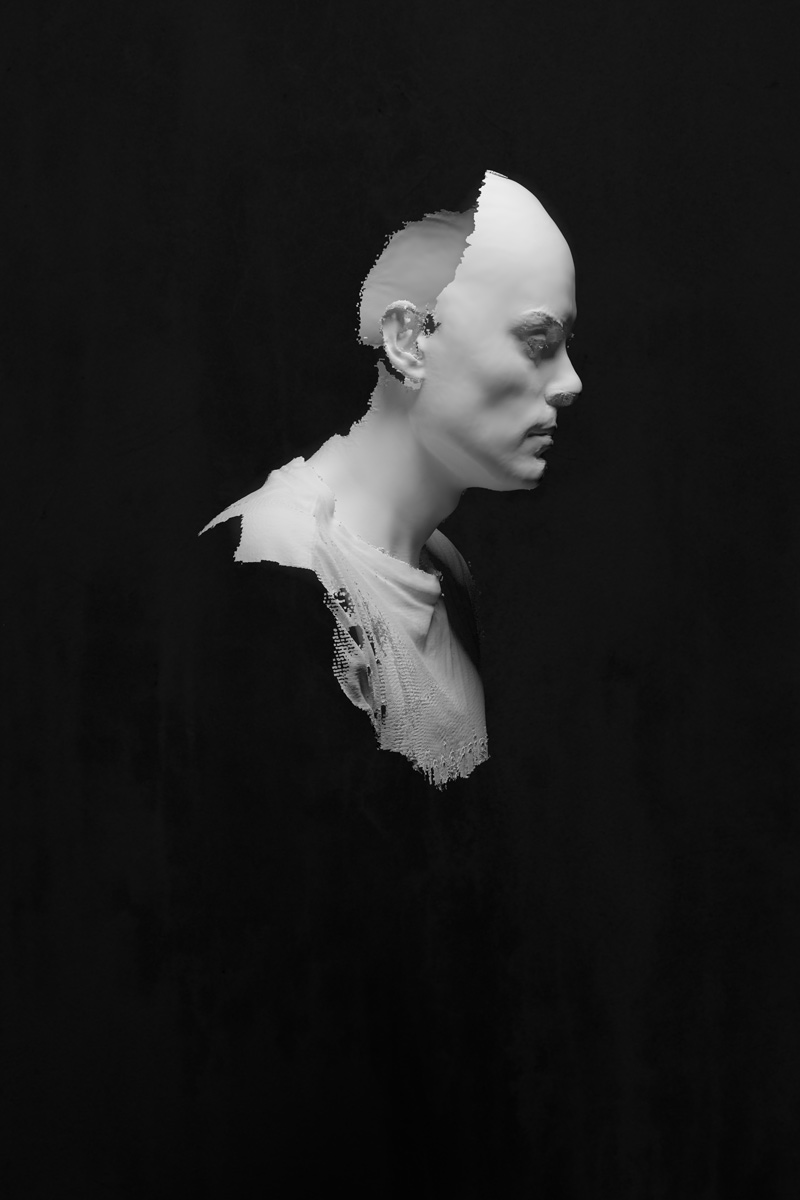
3D self-portrait. 2011. 3D CG image.

